Kafka Streams vs Apache Flink: The Real Decision Guide for 2026
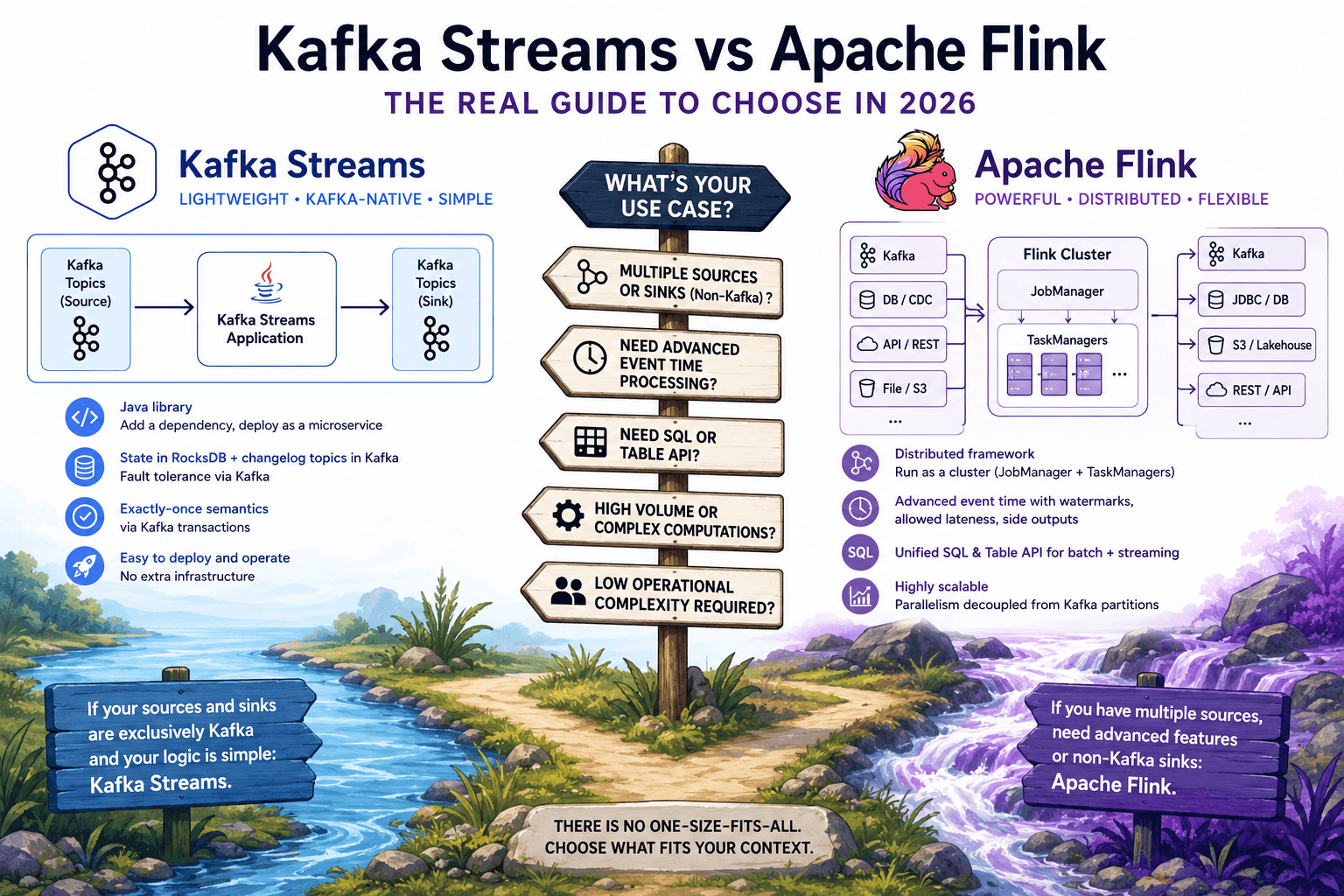
"Kafka Streams or Flink?" It's one of the most common questions when designing a stream processing architecture. And most available comparisons miss the mark, they list features without telling you when to choose one over the other in your real context.
In this article, we'll start from concrete use cases to build a usable decision tree. Not a feature list, a reasoning process.
First, let's clear up a common confusion
Many people compare "Kafka vs Flink." This is a category error.
Apache Kafka is a message broker, it stores and transports events. It doesn't process them. Apache Flink is a processing engine, it consumes streams and produces results. It doesn't store.
They're complementary, not competitors. The real question is: Kafka Streams or Flink as the processing layer on top of Kafka?
What these two tools actually are
Kafka Streams
Kafka Streams is a Java library, not a cluster, not a service. You add a Maven dependency, write your topology, and deploy your application like any other microservice.
StreamsBuilder builder = new StreamsBuilder();
KStream<String, Price> prices = builder.stream("prices-topic");
prices
    .filter((key, price) -> price.getValue() > 0)
    .groupByKey()
    .reduce((p1, p2) -> new Price(p1.getValue() + p2.getValue()))
    .toStream()
    .to("aggregated-prices");
Scaling means running more instances of your application. Each instance handles a subset of Kafka partitions. Included natively: fault tolerance via changelog topics, state management via local RocksDB, exactly-once via Kafka transactions, zero additional infrastructure.
Apache Flink
Flink is a distributed framework with its own cluster. You submit a job to a JobManager, which distributes tasks across TaskManagers.
StreamExecutionEnvironment env = StreamExecutionEnvironment.getExecutionEnvironment();
DataStream<Price> prices = env.fromSource(
    kafkaSource,
    WatermarkStrategy.forBoundedOutOfOrderness(Duration.ofSeconds(2)),
    "price-source"
);
prices
    .keyBy(Price::getAsset)
    .window(TumblingEventTimeWindows.of(Time.minutes(1)))
    .aggregate(new PriceAggregator())
    .sinkTo(timescaleSink);
env.execute();
What Flink adds: multiple sources and sinks (Kafka, JDBC, S3, REST, custom), advanced event time processing with watermarks, unified SQL and Table API for batch + stream, parallelism decoupled from Kafka partition count.
The fundamental difference: Kafka coupling
This is the most important criterion and the one rarely stated clearly.
Kafka Streams without Kafka = nothing. The source must be a Kafka topic, the sink must be a Kafka topic. State stores are saved via Kafka changelog topics. Fault tolerance relies on Kafka offsets.
Flink without Kafka = works perfectly. Kafka is optional. You can read from a REST API, an S3 file, a PostgreSQL database via CDC, and write to TimescaleDB, no Kafka anywhere.
The 5 questions to ask yourself
Question 1: Are your sources and sinks exclusively Kafka?
Yes → Kafka Streams is sufficient. If your pipeline reads from Kafka topics and writes to Kafka topics, Kafka Streams covers the case perfectly. No need for a Flink cluster.
No → Flink. As soon as you read from PostgreSQL via CDC, an external API, or write to a relational database or data warehouse, you need Flink and its native connectors.
Question 2: Do you need event time windows with out-of-order data?
No, or simple stateless processing → Kafka Streams. Filtering, mapping, simple key-based aggregation, Kafka Streams handles this very well.
Yes → Flink. Flink's event time model with watermarks, allowed lateness, and side outputs is far more expressive and mature.
// Flink: fine-grained control over late events
stream
    .keyBy(e -> e.getAsset())
    .window(TumblingEventTimeWindows.of(Time.minutes(1)))
    .allowedLateness(Time.seconds(30))
    .sideOutputLateData(lateTag)
    .aggregate(new PriceAggregator())
Kafka Streams does not offer this level of control over late data.
Question 3: Do you need SQL or a Table API?
No → both work. If your team is comfortable with Java/Scala code, both offer programmatic APIs.
Yes → Flink. Flink SQL is mature in 2026 and supports complex queries directly on streams:
SELECT
    asset,
    AVG(price) as avg_price,
    TUMBLE_END(event_time, INTERVAL '1' MINUTE) as window_end
FROM prices
GROUP BY asset, TUMBLE(event_time, INTERVAL '1' MINUTE)
Kafka Streams has no native SQL, for that you need ksqlDB, which is a separate service.
Question 4: What is your tolerance for operational complexity?
Low → Kafka Streams. Kafka Streams integrates into your existing CI/CD pipeline like any Java application. No cluster to provision, no JobManager, no Kubernetes-specific configuration.
Acceptable → Flink. Flink requires a cluster (JobManager + TaskManagers), checkpoint management, state backend configuration. The Flink Kubernetes Operator simplifies things considerably, but it's still additional infrastructure to operate.
Rule of thumb: if you don't have a dedicated SRE team or data platform, Kafka Streams is operationally safer.
Question 5: What is your data volume and computation complexity?
Moderate volume, simple computations → Kafka Streams. For Kafka-native pipelines with standard transformations, Kafka Streams scales well by adding instances.
High volume or complex computations → Flink. Flink is designed for tens of millions of events per second. Its parallelism is decoupled from Kafka partition count, you can have 4 Kafka partitions and Flink parallelism of 16.
The decision tree
Are your sources/sinks exclusively Kafka?
│
├── YES
│   └── Need advanced event time or native SQL?
│       ├── NO  → Kafka Streams ✅
│       └── YES → Flink ✅
│
└── NO → Flink ✅
Fault tolerance, an important architectural difference
Both guarantee exactly-once, but through different mechanisms.
Kafka Streams saves state via changelog topics in Kafka. On failure, a new instance replays the changelog to rebuild its state store. Fast because the changelog is compacted.
Flink saves state via checkpoints on remote storage (S3, HDFS). On failure, Flink restores the last checkpoint AND repositions the corresponding Kafka offsets. Replay covers the period between the checkpoint and the failure.
The practical consequence: Kafka Streams fault tolerance remains coupled to Kafka. Flink's is independent, you can use any replayable source.
Can they coexist?
Yes, and this is often the right architecture.
External sources (API, DB, IoT)
        ↓
    Apache Flink
(normalization, enrichment)
        ↓
   Kafka topics
        ↓
  Kafka Streams
(Kafka-native business logic,
 event-driven microservices)
Flink for pipelines that need source/sink flexibility and advanced event time. Kafka Streams for simple event-driven microservices living in the Kafka ecosystem.
A real-world example
Let's take a real-time asset price calculation job, a typical fintech use case.
With Kafka Streams: source Kafka topic exchanges, price calculation and simple aggregation, sink Kafka topic prices. Simple, fast to develop, zero additional infrastructure.
With Flink: source 1 Kafka topic exchanges (real-time data), source 2 PostgreSQL (asset reference data), enrichment + price calculation + 1-minute event time window aggregation, sink 1 Kafka topic prices, sink 2 TimescaleDB for analytics. Required as soon as you have multiple sources or a non-Kafka sink.
As soon as TimescaleDB or PostgreSQL enters the equation, it's Flink.
The simple rule
If Kafka is your only data infrastructure and your transformations are simple → Kafka Streams. If you have multiple data sources, advanced event time needs, or non-Kafka sinks → Flink.
The right tool is not the one with the most features, it's the one that matches your operational context and the real complexity of your use case.