The Agentic IDE Is Not the Revolution. It's the First Signal.
When OpenAI acquired Ona and xAI acquired Cursor, most analysts framed it as a battle over the IDE. Who controls the developer's workspace controls the developer. That read is correct but it is also too narrow.
The IDE is not the destination. It is the first visible instance of a much deeper architectural shift in how software is used.
Thirty Years of the Same Paradigm
Since the early days of enterprise software, the interaction model has been essentially unchanged. A user opens an application. They navigate through screens. They fill in forms. They trigger actions. The software responds.
CRM, ERP, support platforms, accounting systems, marketing automation, project management every domain has its own application, its own interface, its own workflow logic. Users learn to operate these interfaces. Expertise, in many domains, is largely the ability to navigate these systems efficiently.
This paradigm has been so stable that we stopped questioning it. It became invisible infrastructure.
What Agentic Workspaces Actually Change
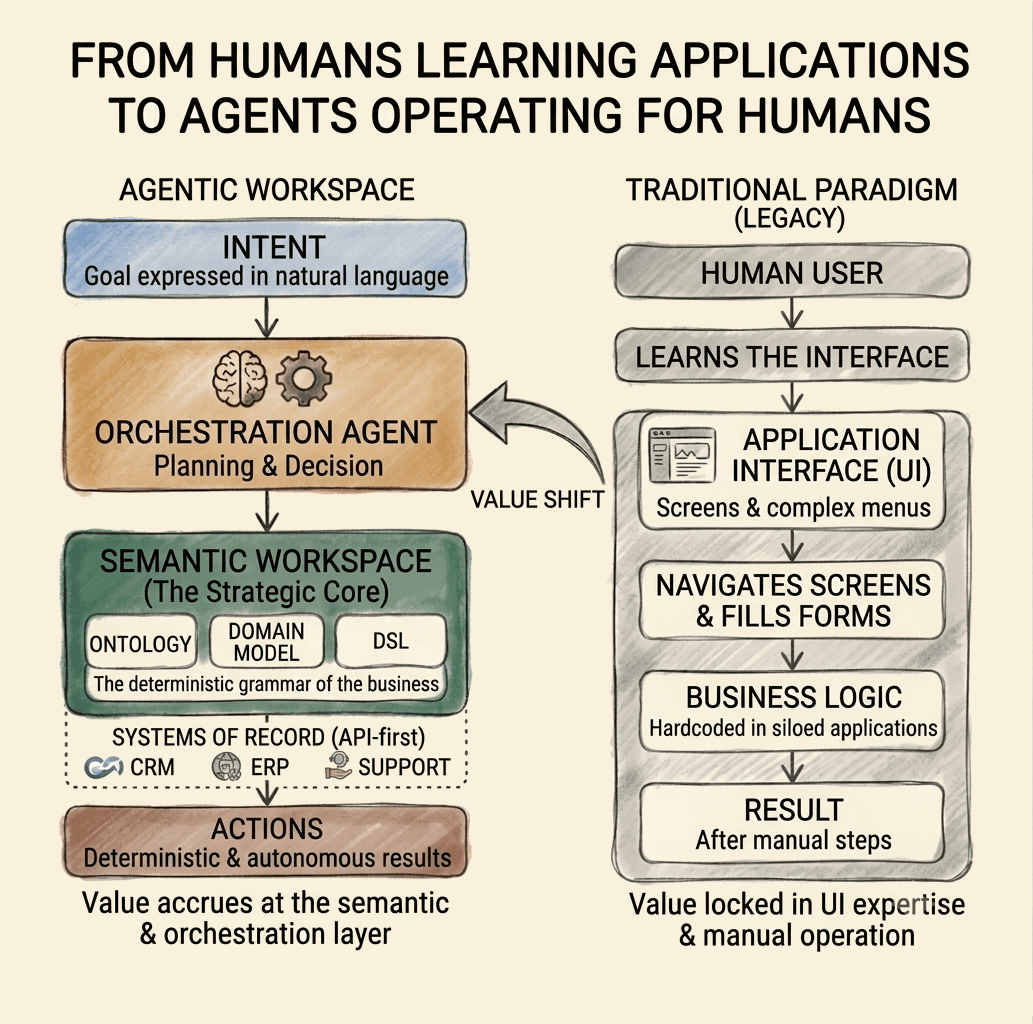
Agentic workspaces propose a different model. The user does not navigate screens. The user expresses objectives.
The agent then mobilizes the tools, data, and workflows needed to reach the desired outcome. The interface is no longer the point of interaction it becomes a layer the agent operates on behalf of the user.
Cursor and its successors do exactly this, but scoped to software development: orchestrating code editors, terminals, test runners, and Git repositories in response to natural language intent. The human describes what they want to build. The agent handles the how.
This is not a developer-specific pattern. It is a general-purpose architectural pattern that happens to have found its first mature expression in the IDE.
The Vertical Expansion
The same model extends cleanly to every domain that runs on structured software workflows.
A business agent orchestrating a CRM, an ERP, a support platform, and a billing system in response to a single objective is structurally identical to Cursor orchestrating a code editor, a terminal, and a test runner. The abstraction level is the same. The value proposition is the same: remove the burden of navigating complex systems from the human, and delegate it to the agent.
This is what makes Salesforce Agentforce, ServiceNow's agentic layer, and SAP Joule worth watching carefully. They are not building AI features into existing applications. They are repositioning their platforms as the operational substrate that agents run on which is a fundamentally different business.
What Happens to the Existing Application Layer
Traditional enterprise applications do not disappear in this model. They become systems of record.
The data lives there. The business logic lives there. The audit trail lives there. What changes is who or what interfaces with them directly. The UI layer, historically designed for human navigation, becomes secondary. What matters is the API surface, the data model, and the semantic precision of the domain.
This is a significant shift in where value accrues. For decades, UX and interface design have been primary competitive differentiators. In an agentic world, the competitive surface moves toward the quality of the underlying domain model, the reliability of the API, and the precision of the business ontology.
Why DSLs and Domain Models Become Strategic Again
For an agent to act reliably in a given domain, it needs to understand that domain. Not approximately precisely. Business rules, constraints, valid state transitions, domain-specific vocabulary: these cannot be improvised at inference time.
This is where domain-specific languages and formal domain models re-enter the picture not as developer tools, but as machine-readable semantics for agents.
A DSL does not disappear when agents arrive. It changes its user profile. Yesterday, a DSL was consumed by a domain expert or a developer. Tomorrow, it is consumed by an agent that needs a structured, unambiguous grammar of the domain to act correctly within it.
The same logic applies to ontologies, workflow definitions, integration schemas, and business rule engines. These artifacts, often underinvested in the API-first era, become foundational infrastructure for agentic systems.
A Fragmentation or a Consolidation?
One plausible trajectory is a proliferation of specialized agentic workspaces one per domain, per vertical, per enterprise context. Each workspace optimized for a specific set of workflows, data models, and business rules. This mirrors how enterprise SaaS fragmented in the 2010s, but at the orchestration layer rather than the application layer.
A competing trajectory is consolidation. If agents can learn to operate any application through its API, the switching cost of the underlying application decreases. A few dominant agentic platforms could absorb multiple verticals, accelerating consolidation rather than fragmentation.
The honest answer is that both dynamics will likely play out consolidation at the generic orchestration layer, fragmentation at the domain-specific workspace layer. The sustainable competitive positions are at the edges, not the middle.
The Shift in One Sentence
We are moving from a world where humans learn to use applications, to a world where agents learn to use applications on behalf of humans.
The IDE is the proof of concept. The enterprise is the market.
The infrastructure that makes this reliable domain models, DSLs, formal ontologies, integration schemas is not a byproduct of this shift. It is a prerequisite for it.